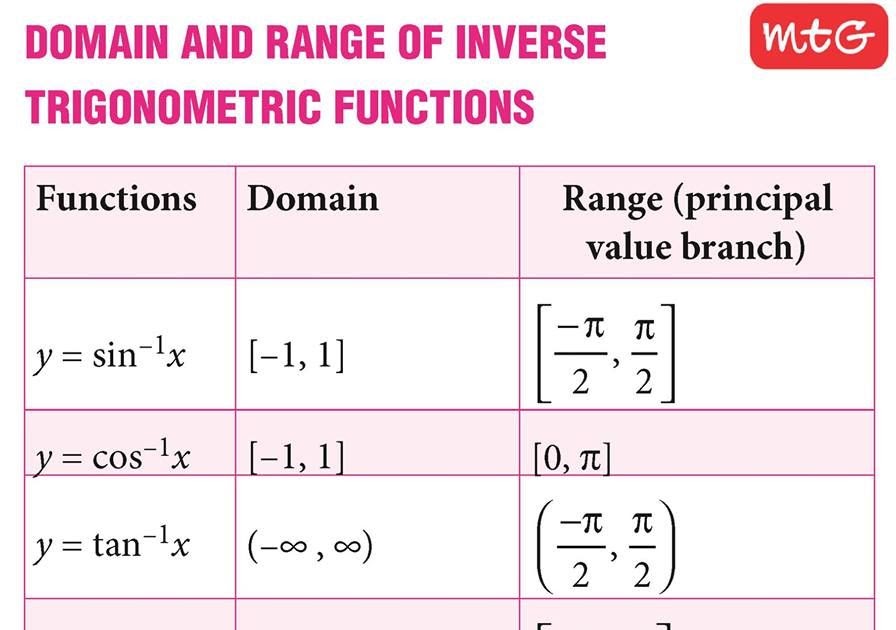
Domain And Range Of Inverse. The inverse trigonometric functions, denoted by s i n − 1 x or (arc sinx), c o s − 1 x etc., denote the angles whose sine, cosine etc, is equal to x. The domain of a function, , is most commonly defined as the set of values for which a function is defined.
Updated Learning Domain And Range Of Inverse Trig Functions from updated-learning.blogspot.com A domain name is the indication of a particular area of authority and autonomy on the Internet. Domain names are utilized to identify various network contexts such as addressing and naming specific to an application. Domain names can also be employed by companies to create website and keep them up to date. Getting a domain name is straightforward and can be completed using an online registration system.
A domain name can be described as an address for a house; it links people to a site. It is accomplished by matching an IP address to a domain name, which gives your computer directions to reach the website. It also aids in search engine optimization. There are thousands of domain registry sites for people to register their domains. Some of them include GoDaddy along with Shopify.
A function's range and domain are usually derived from its graph. Alongside being used to determine the specific function, a domain may be defined in more esoteric ways. For instance, if a expression g's input range is -3, then the Domain of the program will be the value that is located along the dimension of the x-axis.
It is one of the most crucial actions in creating a successful web presence. It lets visitors locate the website they are looking for and is easier to remember than simply a website address. While it's also easier to remember the domain also allows you to make your website search engine friendly by showing it on search results.
Domains and ranges are two of the most useful tools for to determine the ranges of functions. If you're interested in the quadratic range of a function, for example you can graph it by calculating the minimum and maximum numbers of their output. This is usually the most effective method to discover the scope of a given function however it's not the only one.
In addition to TLDs labels. They are a part of TLDs and range from between one and sixty-three characters. Labels can include anything from A to one letter Z. They can have the '-' character, but cannot be the initial or the last character. Some examples of valid labels are 97 and hello-strange-person-16-how-are-you.
The choice of a lengthy, complicated domain name is risky. Many people might misspell it or type it incorrectly. Also, long, complex names could be confusing and could cause conflict with established names. The use of a company's name to bolster your own is a serious mistake that could lead to litigation. You'll have to put in time and money into IP diligence to secure your domain.
Domains are a crucial component of network. They aid in organizing users and network resources . They allow administrators to set the rules for access to these resources. They also permit users to work together and share information.
The domain of a function, , is most commonly defined as the set of values for which a function is defined. Domain of inverse trigonometric functions. Begin with the graph of the cosecant function restrict the.
This Is Because The Output Of The Tangent Function, This Function’s Inverse, Includes All Numbers,.
(b) range of f (x) is also a set of all real numbers. The domain and range calculator finds all possible x and y values for a given function. (c) in order to find the.
Begin With The Graph Of The Cosecant Function Restrict The.
Already we know the range of sin (x). Domain of inverse trigonometric functions. Domain and range of relation:
This Set Is The X Values In A Function Such As F(X).
That is, the range of sin (x) is. Finding the domain and range of the inverse of a relation can be tricky, unless you know the correct steps! Domain and range the domain of a function is the set of values that we are allowed to plug into our function.
It Shows You How To Find The Inverse Function And How To Express The Domain And R.
What is domain and range? A relation is a rule that connects elements in one set to those in another. The range of a function is the.
This Is An Example Demonstrating How To Find The Range Of A Function And How To Find An Inverse Function And Its Domain.
We can visualize the situation. Domain of inverse trigonometric functions. Click the blue arrow to submit.
Post a Comment for "Domain And Range Of Inverse"